What a Casserole Actually Costs: The Hidden Economy of Home-Cooked Kindness Thriving Across America
There's a woman in Knoxville, Tennessee, who keeps a running list on her refrigerator. It's not a grocery list, exactly. It's more like a ledger — except nothing on it has a dollar amount. It tracks who just had a baby, who's recovering from surgery, whose husband is traveling for work, and whose mom just passed. Every few weeks, she fires up her oven and starts cooking. A chicken and rice bake here. A pan of brownies there. A bag of tomatoes from her backyard garden dropped on a porch with a handwritten sticky note.
She's never been paid for any of it. She doesn't expect to be.
"It's not charity," she told a neighbor once. "It's just how people are supposed to live."
She's onto something — something that economists, sociologists, and wellness researchers are starting to pay very close attention to.
The Gift Economy Nobody Talks About
Most of us learned about supply and demand in school. Buy, sell, exchange money for goods. Simple. But running quietly underneath that familiar system is something older, messier, and arguably more human — what anthropologists call a gift economy. No invoices. No Venmo requests. Just the act of giving something meaningful with no expectation of direct repayment.
In communities across the US, this economy runs almost entirely on food.
Facebook groups with names like "Buy Nothing [Your Town]" or "Neighborhood Blessing Box" are full of posts that go something like this: "Made too much lasagna — first come, first served, porch pickup." Or: "Garden went wild this year. Free zucchini and cucumbers. Please take some before I lose my mind." Or simply: "Hard week for our family. Anyone have a meal to share?"
The responses are fast. The generosity is almost startling.
This isn't fringe behavior. It's happening in suburban cul-de-sacs, urban apartment buildings, rural church parking lots, and small-town potluck circles. And it's doing something quietly extraordinary for the people involved.
Why Food, Specifically?
There's a reason nobody's building the same kind of community around exchanging, say, spreadsheet templates or lawn equipment (though those communities exist too). Food is different. It's intimate. Preparing a meal for someone requires you to think about them — their dietary needs, their comfort foods, what might make them feel cared for on a hard day. It takes time. It takes intention.
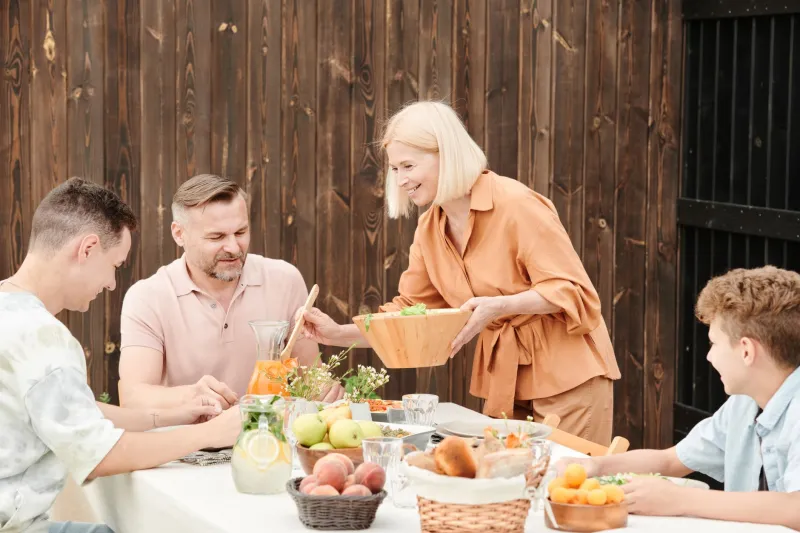
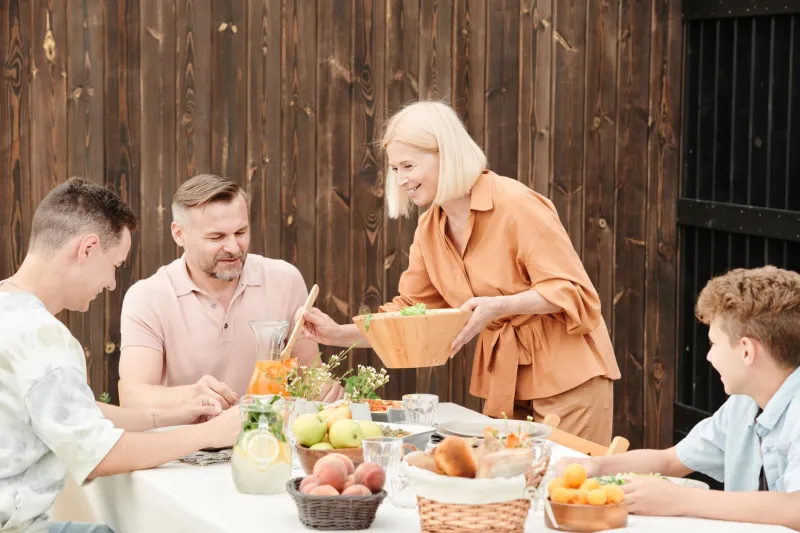
When you hand someone a warm dish of something you made yourself, you are — whether you think of it this way or not — saying: I thought about you. I used my hands and my time and my kitchen for you. You matter enough for this.
That message lands differently than a Grubhub delivery. It lands differently than a text that says "thinking of you." It lands in the body, in the gut, in the part of the brain that processes safety and belonging.
Research backs this up. Studies on social connection consistently show that acts of giving — particularly those that require personal effort — generate stronger feelings of community belonging for both the giver and the receiver. The act of cooking for someone activates what psychologists sometimes call "tend and befriend" behavior, a deeply wired human response that reduces stress hormones and increases feelings of purpose.
In other words, making a casserole for your neighbor might be better for your nervous system than a yoga class. (Don't @ me.)
The Neighborhoods Keeping This Alive
Drive through almost any mid-sized American town and you'll find pockets of this culture if you know where to look. Churches have long been the backbone of food-sharing networks — the women's circle that organizes meal trains, the deacons who quietly stock a freezer for families in crisis. But the tradition has migrated beyond religious institutions.
In Bozeman, Montana, a neighborhood started a "Porch Pantry" exchange where residents leave homemade goods — jams, sourdough loaves, dried herbs — on a shared shelf outside someone's front gate. In Atlanta, a community garden collective has a standing rule: you take what you need, you leave what you can, and everything extra goes to the family down the street who's been struggling since the layoffs.
Online, mutual aid networks have formalized some of this generosity, but the spirit driving it is ancient. People want to feed each other. They want to be fed. And they want to feel, in a world that can seem very transactional, like some things are still just given freely.
What This Does for Mental Health
Let's be honest about the loneliness epidemic in this country. It's real, it's documented, and it's affecting people across every age group and zip code. The US Surgeon General has called it a public health crisis. And while there's no single fix, researchers keep pointing toward the same general direction: we need more genuine, low-stakes, repeated contact with other humans.
Food-sharing communities create exactly that. When you're part of a meal train, a neighborhood produce swap, or a church cooking brigade, you have built-in reasons to show up for each other — not in a grand, performative way, but in the ordinary, sustainable way that actually builds trust over time.
You learn that Linda two streets over makes the best banana bread in the county. You find out that the couple in the blue house is going through something hard. You discover that the teenager next door has started baking as a way to cope with anxiety, and she'd love someone to give her cookies to. These are the threads that weave a community together. And they start, so often, with someone deciding to make a little extra.
How to Step Into This, Even If It Feels Awkward
Maybe you're reading this and thinking: I'm not a great cook. I don't know my neighbors that well. This feels like a lot. Totally fair. Here's the thing though — the bar is genuinely low. You don't need a signature dish or a spotless kitchen or a reason bigger than "I just felt like it."
A few easy entry points:
- Double your next batch of soup or chili and drop a container on a neighbor's porch. Leave a note. You don't even have to knock.
- Join a local Buy Nothing group and watch for food-related posts. Respond to one. Offer something from your own kitchen when you have extra.
- Check with your church, mosque, synagogue, or community center about whether they run a meal ministry. Many are quietly desperate for more hands.
- Start small in your own home. Invite one person over for dinner who you suspect might be lonely. It doesn't have to be fancy. It just has to be real.
The casserole economy doesn't ask for perfection. It just asks for presence.
The Most Radical Thing You Can Do
In a culture that monetizes nearly everything — including wellness — there's something genuinely subversive about feeding people for free. About deciding that your time and your kitchen and your effort are worth giving away, not because you'll get something back, but because that's just how people are supposed to live.
That woman in Knoxville with her refrigerator list? She's not doing anything revolutionary. She's doing something ancient. And in doing it, she's probably healthier, more connected, and more rooted in her community than most of the people scrolling wellness content at midnight wondering why they feel so alone.
Maybe the most nourishing thing you can do this week has nothing to do with what you eat — and everything to do with what you cook for someone else.