What Small Towns Know About Saying Hello That the Rest of Us Have Forgotten
When journalist and wellness writer Petra Simmons moved from Chicago to a town of 4,000 people in central Vermont, she expected the quiet. The slower pace. Maybe some good maple syrup.
What she didn't expect was to feel, within two weeks, less lonely than she had in years.
"It wasn't the scenery," she told me. "It was the fact that every single person I passed on the sidewalk looked at me. Actually looked at me. And said something. Even if it was just 'morning.' I felt visible in a way I'd forgotten was possible."
Petra's experience isn't unique. Across the country, people who've moved from dense urban centers to smaller communities report a version of the same quiet shock: the greeting culture. The eye contact. The acknowledgment that you exist in shared space with other human beings who notice you.
It sounds like such a small thing. The research says it isn't.
The Science of Being Seen
Human beings are wired for acknowledgment. From the earliest moments of development, we orient toward faces, toward eye contact, toward the signal that we have been registered by another consciousness. This isn't sentimentality — it's neurobiology.
Studies on what researchers call social acknowledgment consistently show that even brief, low-stakes positive interactions with strangers — a smile, a nod, a quick exchange of words — produce measurable improvements in mood and sense of belonging. Conversely, being ignored, looked through, or treated as invisible produces a stress response similar to mild social rejection. The brain doesn't always distinguish between the two.
"We tend to think that meaningful social connection requires depth — long conversations, close relationships," says Dr. Alicia Fong, a social psychologist at the University of Michigan. "But the data shows that the cumulative effect of many small, positive micro-interactions throughout the day has a significant impact on wellbeing. A genuine 'hello' from someone on the street is not nothing. It's genuinely doing something."
In small towns where greeting culture is still intact, residents are essentially receiving dozens of these micro-doses of acknowledgment every day. And they often don't even notice it — because it's just how things work there.
Life on the Greeting Side
Spend a morning in Staunton, Virginia — population around 25,000, small enough to still feel like a town — and you'll notice it immediately. Shopkeepers wave. Dog walkers make eye contact and comment on your shoes. The guy at the coffee counter asks if you're visiting and, when you say yes, gives you three restaurant recommendations and a brief history of the town square.
None of this feels performative. That's the key thing. It feels like the default.
"People think small-town friendliness is a myth or a stereotype," says Maren Ellis, who has lived in Staunton her whole life and now runs a local bakery. "But it's really just a habit. We were raised to look at people. To say something. It doesn't cost anything, and it makes the whole day feel different — for you and for them."
In Taos, New Mexico, where the community is a mix of longtime locals, Indigenous residents, and artists who've settled from elsewhere, a similar culture persists. Longtime resident and community organizer Ray Lujan describes it as "a responsibility you take on when you share a place with people."
"If I walk past someone and don't acknowledge them, I've done something. I've made a choice. In a small community, you can't pretend that choice is neutral," he says. "So we don't. We say hello. We ask how the family is. It keeps the fabric of the place intact."
Urban Anonymity: A Feature or a Bug?
It would be easy — and unfair — to simply frame city life as the villain here. Urban anonymity serves a real function. When you share a subway car with three hundred strangers twice a day, you develop norms of non-engagement as a form of mutual respect. Personal space becomes more precious when physical space is scarce.
But there's a cost. And more urban residents are starting to name it.
A 2023 Gallup survey found that Americans living in large cities reported significantly higher rates of loneliness and lower rates of feeling known by their neighbors than those in smaller communities. Nearly 40% of urban respondents said they didn't know their neighbors' names. That number dropped to under 15% in towns with populations below 10,000.
"I'm not anti-city," says Dr. Fong. "Cities are extraordinary in a thousand ways. But we've allowed a norm of invisibility to take hold in dense places, and we're paying for it in loneliness and disconnection. The good news is that norms are changeable. They're just habits. And habits can be built."
The Hello Experiment: A Roadmap for Any Zip Code
Here's what the research and the small-town wisdom both point toward: greeting people is a practice. Like any practice, it gets easier and more natural the more you do it. And like any practice, it starts with a decision.
If you want to revive the culture of genuine greeting in your own life — whether you're in a suburb of Dallas or an apartment building in Seattle — here's where to start:
Make eye contact before you speak. The greeting starts before the words. A moment of actual eye contact signals that you're present and that you see the other person as a person. This alone changes the quality of any interaction.
Use people's names when you know them. This applies to the barista, the mail carrier, the person at the front desk of your gym. Learning and using someone's name is one of the most efficient forms of acknowledgment that exists.
Tolerate the awkwardness. In places where greeting culture has faded, the first person to revive it often feels a little silly. Someone might not respond. Someone might look surprised. Do it anyway. Norms shift one person at a time.
Start with your immediate geography. Your apartment hallway. Your block. The parking lot of your grocery store. You don't have to greet the whole city. You have to greet the people whose paths naturally cross yours.
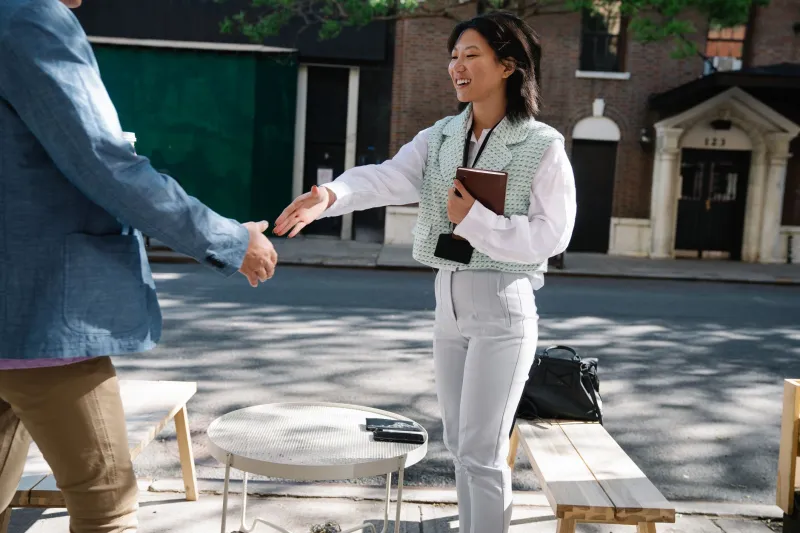
Let it be brief. A genuine hello is not a commitment to a conversation. It's an acknowledgment. "Morning" is enough. A nod and a smile is enough. The point is the recognition, not the duration.
The Smallest Revolution
Petra Simmons still lives in Vermont. She's been there three years now. She says the greeting culture is the thing she would miss most if she left.
"It sounds so small when I describe it," she told me. "But what it actually does is remind you, every single day, that you're part of something. That you belong to a place and the people in it. I don't think I understood how much I needed that until I had it."
That feeling — of belonging to a place, of being seen within it — is exactly what Emma's Hug is about. Not grand gestures. Not elaborate community-building projects. Just the daily, repeated, intentional act of turning toward each other.
Say hello. Mean it. See what changes.