Cook Like Someone Is Counting On You: The Beautiful Practice of Making Food From Someone Else's Story
My friend Cora has a laminated index card taped to the inside of her cabinet door. It's her late mother's sweet potato pie recipe, written in pencil so faded you have to tilt it toward the light to read the measurements. She's made the pie maybe forty times since her mom passed. She says it's the only time she doesn't miss her.
That's what a recipe actually is, when it's doing its real work. Not a set of instructions. A relationship, preserved in flour and time.
The Story Is the Ingredient You Can't Buy
There's a reason food writers keep coming back to the intersection of memory and cooking. It's not nostalgia for nostalgia's sake. It's because the act of making food the way someone else made it — following their logic, their proportions, their particular quirks — creates a kind of intimacy that's hard to find anywhere else.
When you make your grandmother's biscuits, you're not just making biscuits. You're inhabiting her kitchen for an hour. You're holding the same bowl she held. Your hands are doing what her hands did. There's a continuity in that which goes beyond sentiment.
Reader Tamara J. from Birmingham, Alabama, submitted her family's recipe for red beans and rice to Emma's Hug recently, along with a note that stopped me cold. She wrote: "My daddy made this every Monday without fail. When I make it now, my kids don't know they're eating history. But they are."
That's it. That's the whole thing.
What Happens When We Stop Asking
Here's the part that keeps me up at night: we are losing these recipes at a pace we can't fully see.
Every year, people who carry irreplaceable culinary knowledge — regional traditions, immigrant family adaptations, handmade techniques passed down without ever being written down — age out of being able to share them. And because we live in a world of infinite online recipes, we sometimes forget that the one that actually matters is the one sitting across the Thanksgiving table from us, in the hands of someone who won't be there forever.
"I can't tell you how many people come into grief counseling and mention a recipe they wish they'd asked for," says Nashville-based counselor Priya Mehta. "It sounds small. It isn't. That recipe was a portal to a relationship, and now the portal is closed. The grief around that is real."
Reader Marcus T. from Houston knows this firsthand. He submitted his mother's tamale recipe — painstakingly reconstructed from memory and three phone calls with aunts — along with this note: "She never measured anything. I spent two years trying to get it right. I still don't know if it is. But every Christmas I make them and my kids call it 'Grandma's tamales,' and I think that's close enough to right."
The Radical Act of Asking
So what do we do about it? We ask. Before it's too late, we ask.
This sounds simple. It is simple. It is also something most of us don't do, because asking someone for their recipe requires a kind of intentionality that our busy lives don't always make room for. It requires sitting down, being present, and saying: Your food matters to me. Tell me how you make it.
Here's a gentle framework for doing exactly that:
Start with the dish that means something to you. Not the most impressive thing they make — the thing that you associate with them. The one that makes you think of them when you smell it somewhere else.
Ask for the story first, the recipe second. Say: "Where did you learn to make this?" or "Who taught you?" Let the narrative come before the measurements. You'll get a better recipe, and you'll get something more valuable than the recipe.
Write it down in their words. Don't translate into standard recipe format right away. Keep the phrase "a good handful" instead of converting it to a quarter cup. Keep "cook it until it smells right." That's the voice. That's what you're preserving.
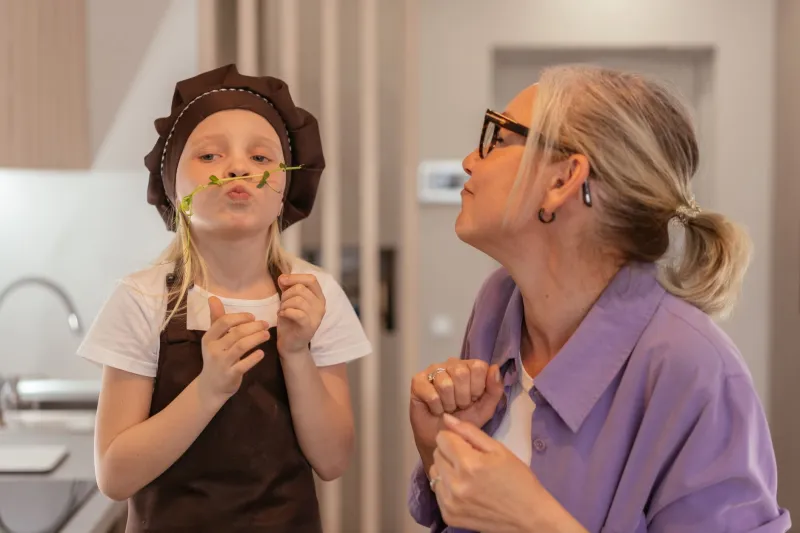
Make it with them, if you can. Watch their hands. Notice what they do that they don't say out loud — the way they test the dough, the moment they decide it's done. Those instincts don't always make it onto paper.
Recipes From the Emma's Hug Community
We put out a call to our readers, and what came back was extraordinary. Not just recipes — reasons.
Reader Sofia M. from Chicago sent her Sicilian grandmother's caponata, a sweet-sour eggplant dish she'd never seen in any restaurant. "My nonna said she learned it from her mother, who brought it over from Palermo. I've been making it every summer for twelve years. My neighbors think I invented it. I let them believe that a little, because it makes me feel close to her."
Reader DeShawn F. from Memphis sent his father's dry rub for ribs, with this note: "He made this on a grill he built himself in the backyard. I don't have that grill anymore. But I have this."
Reader Lena K. from Portland sent her Korean grandmother's kimchi jjigae recipe, scanned from a handwritten notebook her grandmother kept in Korean. "I had it translated by a friend. Some of the instructions didn't fully translate. I think that's okay. I think some of it is supposed to stay in her language."
Every single one of these recipes is also a portrait of a person. Of a relationship. Of something that was loved enough to be carried forward.
How to Cook Like You're Feeding Someone You Love
You don't have to be cooking a family heirloom to bring this energy to your kitchen. You just have to cook with intention.
Ask yourself, before you start: Who is this for? Even if you're cooking for yourself, answer the question. Think about what would make this person feel held, seen, satisfied. Let that guide your choices — not just the recipe, but the care you put into it.
Food cooked with attention tastes different. Not because attention is a literal ingredient, but because attention changes the cook. It slows you down. It makes you present. And presence is something people can taste.
Cora's laminated sweet potato pie card is still taped to her cabinet. She's thinking about making copies for her kids. She wants them to have the recipe and the story — the pencil-faded measurements and the knowledge that this is what love looked like in her mother's hands.
That's the whole point. That's what we're really cooking.