Side by Side, Step by Step: Why a Walk Can Do What a Face-to-Face Talk Can't
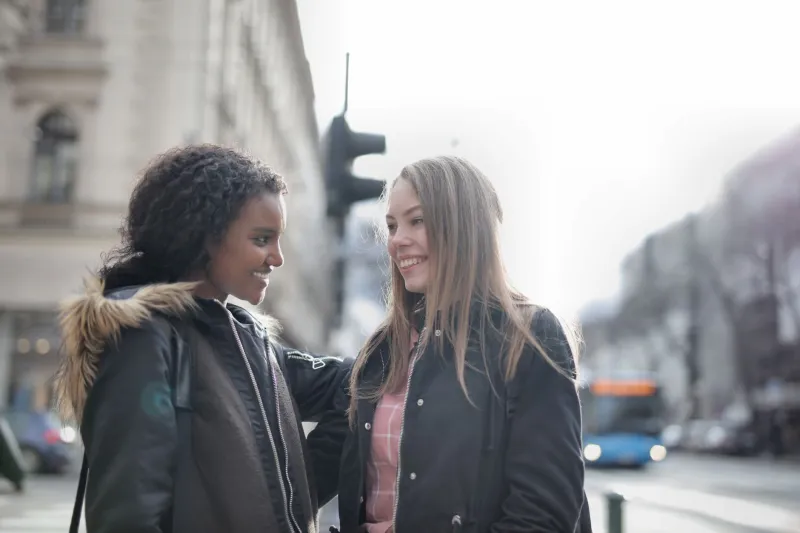
At Emma's Hug, we talk a lot about the small rituals that make people feel less alone. A text. A casserole. A note tucked under a windshield wiper. But there's another ritual that costs nothing, requires no hostess gift, and has a way of sneaking past our defenses: the walk.
Not a hike. Not a fitness challenge. Just two people, moving in the same direction, talking about whatever comes up.
We've been trained to think that serious conversations require a table. Two chairs. Maybe a pot of coffee and a box of tissues. That setup works for some people. For plenty of others, it feels like a deposition. The eye contact is intense. The silence is loud. The whole thing can start to feel like a performance review for your personal life.
Walking changes the physics of a conversation. You're not staring at each other. You're looking at the sidewalk, a dog, a row of mailboxes, the sky. Your bodies are doing something ordinary, and that ordinary motion gives the talk somewhere to land.
The Pressure of the Table
Think about the last hard conversation you had. Maybe it was with a partner, a parent, a friend, or a coworker. Chances are there was a moment when you wished you could look anywhere else. A table can make honesty feel formal. It can also make silence feel like a failure.
When you're walking, silence isn't a dead end. It's just a pause. You can watch a squirrel make a bad decision. You can wait for a car to pass. You can keep moving. That tiny bit of motion takes the edge off.
Therapists often call this 'walk-and-talk' or 'side-by-side' conversation. The idea isn't new. Counselors have used walking sessions for years, especially with people who find traditional face-to-face therapy uncomfortable. The same principle works outside an office. A sidewalk, a park loop, or a quiet stretch of neighborhood can become a low-pressure room with no walls.
What Side-by-Side Does to a Conversation
Psychologists and communication researchers have long noted that eye contact is powerful, but it can also be overwhelming. For some people, especially those who are anxious, autistic, or simply private, direct eye contact makes it harder to think and speak. Looking forward can free up attention. You're not managing your face. You're just talking.
There's also something about shared movement that makes a conversation feel collaborative. You're not sitting opposite each other like two sides of a negotiation. You're going the same way. That matters more than we tend to admit.
And then there's the simple fact that walking is good for you. It helps burn off nervous energy. It gets blood moving. It gives your hands something to do. If you've ever tried to say something difficult while your heart was pounding, you know that a little physical movement can make the words come out less jagged.
For the People Who'd Rather Fix the Fence
Let's be honest: a lot of men in the U.S. have been raised to treat face-to-face emotional conversations like a trap. Not all men, of course. But many have learned to show care by doing something — fixing a fence, changing the oil, carrying the heavy thing — rather than sitting down and naming a feeling.
A walk fits that instinct. It's active. It's practical. It doesn't require anyone to announce that we are now having a serious talk. You can just say, 'Hey, want to take a lap around the block?' That's a lot easier to accept than 'We need to sit down.'
The same goes for teenagers, siblings, and anyone who dreads the intensity of a formal sit-down. A walk says: I want to be with you for a few minutes. It doesn't demand a confession. It just opens a door.
How to Make the Walk Happen
You don't need a plan. You need shoes and a small invitation.
- Keep it short. A 15-minute loop around the block is enough. You can always keep going if it's working.
- Pick a low-stakes route. A familiar park, a quiet street, a path you both know. The point is not adventure. The point is conversation.
- Don't force the big topic immediately. Start with the dog, the weather, the weird mailbox down the street. Let the talk find its own pace.
- Walk side by side, not single file. If the sidewalk is narrow, slow down. The physical arrangement matters.
- Leave room for silence. It's not a sign that you're failing. It's a sign that you're both human.
If you're the one who needs to talk, try saying, 'I've got something on my mind. Could we walk sometime this week?' That's often easier to hear than an invitation to a heavy sit-down. If you're the one being asked, say yes if you can. You don't need to prepare a speech. You just need to show up.
The Invitation Is the Hard Part
At Emma's Hug, we believe connection doesn't always need a grand gesture. Sometimes it looks like a casserole on a porch. Sometimes it looks like a two-sentence text. And sometimes it looks like two people walking past the same houses they've walked past a hundred times, finally saying the thing that's been sitting in the middle of the living room.
So the next time you need to really talk — or the next time someone you love seems to be carrying something heavy — consider skipping the table. Lace up your shoes. Ask for a walk. The sidewalk might not solve everything, but it can make the first mile a whole lot easier.